


Permit Fees for Motor Vehicles in India
Permit fees for motor vehicles in India vary by permit type and vehicle class, and each permit is a government authorisation that lets a transport vehicle run on public roads. State and Regional Transport Authorities issue permits under the Motor Vehicles Act, 1988. This page covers local, national, tourist and temporary permit fees, renewal charges and how to apply.
What is a Motor Vehicle Permit?
A motor vehicle permit is a legal document issued by the government that allows the vehicle to run on public roads and is a mandatory requirement for all those who drive commercial or transport vehicles. Transport authorities check for these permits while highway patrolling as per the Motor Vehicle Act 1988.
What are the Different Types of Motor Vehicle Permits?
Motor vehicle permits are categorised into two main types. Here are the types of permits, which are sub-divided into following categories:
1. Permits for Goods Vehicles
Goods Carrier Permits:
✅ Issued under Section 79 of the Motor Vehicles Act, 1988.
✅ Granted to goods vehicles operating within a state for carrying a specific load within a designated area.
Counter Signatures for Goods Carrier Permits:
✅ Initially issued in one state and endorsed in another by the concerned State or Regional Transport Authority under Section 88 of the Motor Vehicles Act, 1988.
✅ Delhi Government Notification (2006): Counter-signatures are not provided for goods vehicles:
- Registered in other states.
- Gross vehicle weight up to 7,500 kg if not running on clean fuel.
National Permits:
✅ Allow goods vehicles to travel outside their home state, throughout the territory of India on payment of the composite fee.
✅ Eligibility: Vehicle age must not exceed 12 years (or 15 years for multi-axle vehicles).
✅ Application: Forms 46 and 48 must be submitted along with other formalities.
2. Permits for Passenger Vehicles
Auto Rickshaw and Taxi Permits:
✅ Issued by MLO (AR) Burari for passenger transport within Delhi.
✅ Fare Structure:
- Auto Rickshaw: Rs.30 for the first 1.5km, then Rs.11 for each additional km.
- Taxi: Rs.40 for the first km, then Rs.17 for each additional km (non-AC taxi) or Rs.20 for each additional km (AC taxi).
Maxicab Permits:
✅ Issued by STA for vehicles operating on fixed routes within Delhi.
✅ Capacity: Maximum seating of 12, excluding the driver.
✅ Fare: Determined by STA.
Phat Phat Sewa Permits:
✅ Originally issued for Harley-Davidson engine three-wheeled vehicles.
✅ Replaced by vehicles with up to 9 seats.
✅ Operate on fixed routes, charging fares as per STA approval.
Eco-Friendly Sewa Permits:
✅ Issued for battery-operated 3-wheeled vehicles with seating for up to 10 passengers.
Contract Carriage Bus Permits (Chartered Buses):
✅ Commonly used for hire and reward.
✅ Agreement required between client and operator, with a passenger list available to the driver.
✅ Passengers other than those on the list cannot be picked up.
✅ Issued under Section 74 of the Motor Vehicles Act, 1988.
✅ Application: Must be made on Form PCA along with other formalities.
Stage Carriage Permits:
✅ Issued by STA based on route demand.
✅ Allows buses to pick up passengers along assigned routes.
✅ Covers DTC and private stage carriage buses.
3. Temporary Permits
✅ Issued under Section 87 of the Motor Vehicles Act, 1988 for a limited period.
✅ Purpose: Allows transport vehicles to operate outside Delhi for:
- Special Occasions: Transporting passengers to and from events like fairs and religious gatherings.
- Seasonal Business: Serving specific seasonal demands.
- Temporary Needs: Addressing short-term transport requirements.
- Pending Permit Renewal: While awaiting decision on permit renewal applications.
✅ Application: Must be made on Form P. TEMP. A.DLY/DLZ.
4. All India Tourist Permits (AITP)
✅ Issued for Luxury Buses.
✅ Vehicle must be white with a blue ribbon (5 cm width) along the center.
✅ “Tourist” should be displayed on both sides in a 60 cm diameter circle.
Vehicle Age Limits:
- Motor Cabs: A permit is not granted to a tourist vehicle after 12 years from the date of its first registration.
- Non-Motor Cabs: For diesel vehicles registered in the National Capital Territory of Delhi, a permit is not granted after 10 years from the date of first registration.
- Replacement vehicles must not be older than 2 years.
Seating Layout:
- Forward-facing seats in 2x2, 1x2, or 1x1 configuration.
Required Facilities:
- Public address system, drinking water, reclining seats, fans, curtains, separate driver cabin, etc.
✅ Application: Form 1 must be submitted in electronic form on the portal.
✅ Identification: Must display “All India Tourist Permit” on the rear left side in white letters on a blue background, along with the validity of the permit.
The All India Tourist Permit fee under the All India Tourist Vehicles (Permit) Rules, 2023 depends on the passenger capacity of the tourist vehicle, excluding the driver. The permit is valid for 90 days or multiples of 90 days, up to five years at a time, and no permit fee is charged for battery-operated tourist vehicles or tourist vehicles driven on methanol or ethanol fuel.
Category of tourist vehicle (passenger capacity excluding driver) | Annual fee | Quarterly fee |
Less than five | Rs.20,000 | Rs.6,000 |
Five or more but less than ten | Rs.30,000 | Rs.9,000 |
Ten or more but less than 23 | Rs.80,000 | Rs.24,000 |
23 or more | Rs.3 lakh | Rs.90,000 |
5. Rent-a-Cab Permits
✅ Introduced in 1989 for multinational companies and tourists.
✅ Self-Drive Scheme: Passengers drive the vehicle themselves; fare is based on the number of days the cab is used.
Applicant Requirements:
- 24-hour accessible telephone.
- Adequate parking space.
- Experience in passenger transport business.
- Fleet of 50 cabs, with at least 50% air-conditioned.
✅ Validity: Permits valid throughout India, provided passenger taxes are paid to respective states.
6. Institution or School Bus Permits
✅ Issued to vehicles of educational institutions registered under the Societies Act, 1960 (21 of 1960).
✅ Exempted from road tax.
✅ Identification: Buses painted in golden yellow colour.
✅ Safety: Must comply with additional child safety provisions under the Delhi Motor Vehicles Rules, 1993.
Local Permit Fees for Different Categories of Vehicles
If the owner of a motor vehicle wants to apply for a local permit, the charges levied for different categories of vehicles is as follows:
The local permit fees, the national permit fees and the other permit fees on this page are those notified by the State Transport Authority, Government of NCT of Delhi.
Class of the vehicle | Fees levied | Permit Validity |
Light goods vehicle (LGV) | Rs.2000 | 5 years |
Heavy goods vehicle (HGV) | Rs.2500 | 5 years |
For authorisation in case of a Light Goods Vehicle | Rs. 500 | 1 year |
National Permit fees for Different Categories of Vehicles
If the owner of a motor vehicle wants to apply for a national permit, he has to pay the national permit composite fee, which covers operation throughout India. The charges levied for different categories of vehicles are as follows:
Class of the vehicle | Fees levied | Permit Validity |
Light goods vehicle (LGV) | Rs.2015 | 5 years |
Heavy goods vehicle (HGV) | Rs.2515 | 5 years |
For authorisation in case of a Light Goods Vehicle | Rs. 500 | 1 year |
National Permit for Different States in India
The national permit composite fee is uniform across all states and Union Territories. The table below shows the composite fee for a few of the states.
Name of the State | National Permit Fees |
Haryana | Rs.16,500 per annum |
Rajasthan | Rs.16,500 per annum |
Madhya Pradesh | Rs.16,500 per annum |
Uttar Pradesh | Rs.16,500 per annum |
Himachal Pradesh | Rs.16,500 per annum |
Jammu and Kashmir | Rs.16,500 per annum |
Punjab | Rs.16,500 per annum |
Bihar | Rs.16,500 per annum |
Gujarat | Rs.16,500 per annum |
Maharashtra | Rs.16,500 per annum |
Odisha | Rs.16,500 per annum |
West Bengal | Rs.16,500 per annum |
Kerala | Rs.16,500 per annum |
Assam | Rs.16,500 per annum |
Meghalaya | Rs.16,500 per annum |
Tamil Nadu | Rs.16,500 per annum |
Andhra Pradesh | Rs.16,500 per annum |
Chandigarh | Rs.16,500 per annum |
Puducherry | Rs.16,500 per annum |
Other Fees and Charges for Different Permits
Type of permit | Permit fees | Permit Validity |
Light Goods Vehicle (LGV) | Rs.1215 | For 5 years |
Heavy Goods Vehicle (HGV) | Rs.1615 | For 5 years |
Contract Carriage Permit for buses | Rs.1100 | For 5 years |
All India Tourist Permit for buses | Rs.20,000 to Rs.3 lakh annually, depending on passenger capacity | For 1 year |
Stage Carriage Permit for Red line, Blue lines, Suvidha and Interstate Permits (Renewal fee) | Rs.1100 | For 5 years |
Point to Point Permit | Rs.500 | For 4 months |
Counter signature for Haryana & Punjab State | ||
LGV | Rs.1500 | For 5 years |
HMV | Rs.2500 | For 5 years |
Counter Signature for other State Stage Carriage | Rs.2500 | For 5 years |
Note:
- Temporary Permit will be issued at Rs. 20 per day which is subject to tax paid to Borders.
- The All India Tourist Permit fee is paid once on the portal and the permit is valid throughout India; the fee collected is distributed among the States and Union Territories.
Renewal of Permit and Associated Charges
The details on permit renewals and charges levied for it are given below:
- A permit, other than a temporary permit, issued under Section 87 or a special permit under Section 88(8), is valid for 5 years from the date of issuance or renewal.
- The renewal fee for the permit is the same as the issuance fee.
- To renew the permit, the applicant must submit a Permit Renewal Application (PRA) along with the renewal fee and other required documents at least 15 days before the permit expires.
- If the renewal fee is not paid by the due date, a late fee will be charged.
- For All India Tourist Permits, National Permits, or Interstate Permits, a late fee of Rs.20 per day will apply until the fee is paid before the permit's renewal or issuance.
- The fee for issuing a duplicate permit is half of the original permit fee.
Type of vehicle | Charge levied for late payment of permit renewal fee | |
Up to permit's expiry | After permit's expiry | |
Auto Rickshaw | Rs.50 | Rs.50 + Rs. 3 per day |
Local Taxis | Rs.100 | Rs.100 + Rs. 10 per day |
Light Motor Vehicles/ Medium Motor Vehicles/ Deluxe Taxis/ All India Tourist Taxis | Rs.200 | Rs.200 + Rs. 50 per day |
Heavy Motor Vehicles/ Heavy Goods Vehicle | Rs.300 | Rs.300 + Rs. 20 per day |
Replacement of a Vehicle
The following are the points that should be remembered in case of replacement of a vehicle:
- The permit holder may replace any vehicle covered by the permit with another vehicle of the same type, with prior permission from the granting authority.
- A period of 4 months is allowed for the vehicle replacement in a permit deposited under the replacement mode, starting from the date of deposit.
- At the time of grant, renewal, or transfer of a permit, the applicant is required to submit a self-attested photocopy of their PAN card and Bank Account Number.
- This requirement was resolved by the State Transport Authority, Government of NCT of Delhi, in meetings held on 7.4.2006 and 18.4.2006 (Resolution No. 21/2006).
- The PAN card and bank account details will be part of the office records and maintained in the computerized data record.
- There is also a requirement for a Speed Limiting Device on the vehicle.
- If the four month period expires, the late charges levied on the holder of the permit are as follows:
Time Period (After the lapse of four months) | Late Fee (Per day) |
First 30 days | Rs.10 |
From 31st to 60th day | Rs.20 |
From 61st to 120th day | Rs.40 |
From 121st to 180th day | Rs.60 |
From 181st day | Rs.100 |
Process to Apply for a Vehicle Permit
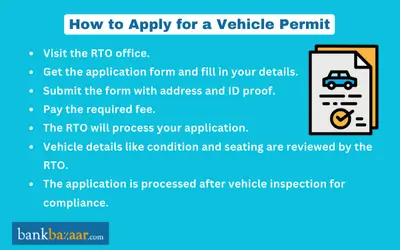
The steps to apply for a vehicle permit are as follows:
Step 1: Visit the relevant RTO office.
Step 2: Obtain the required application forms from the RTO and fill them out with your details.
Step 3: Submit the form along with address and identity proof.
Step 4: Pay the required fee.
Step 5: The RTO authorities will process your application.
Step 6: The vehicle’s condition, body, seating arrangements, and other details will be included in the permit and handled by the RTO authorities.
Step 7: The application will then be processed further after the vehicle has been examined for appropriateness and compliance with other essential conditions.
Process to Obtain Duplicate Permit
The steps to obtain duplicate permit are given below:
- Login on VAHAN Parivahan portal using your credentials.
- Navigate to "Online Permit".
- Select "Application for Duplicate Permit".
- Enter Registration Number and Chassis Number.
- Click on Generate OTP.
- OTP will be received on registered mobile number.
- Click on the Submit button.
- Click on "Duplicate Permit" under "Service Details".
- Fill in the required details and press Submit.
- Under "Service Details", click on "Insurance Details".
- Fill in the details and click on "Submit".
- Click on DMS (Upload Docs) to upload the required documents.
- Click on "Select" and choose the desired file to upload.
- Click 'x' button once you are done.
- Click on "Fee Details" under "Service Details".
- Click on Make Payment.
- Submit and proceed to pay the required amount.
- Select payment gateway as per your preference and accept the terms and conditions.
- Then click on "Continue".
Documents Required for a Vehicle Permit
The documents necessary to apply for a vehicle permit are as follows:
- Application form number 46 and 48
- Vehicle’s Fitness Certificate
- Proof of current quarter tax payments for the Homebased State National
- National Permit Fee
- Payment of any applicable green taxes
- Vehicle’s Insurance Certificate
- Demand drafts agreed upon for the payment of all taxes for other states in favour of the Transportation Authorities
- Vehicle Registration Certificate
A commercial vehicle applying for a National Permit must not have any unpaid National Highway user fee (toll) dues, as required by the Central Motor Vehicles (Second Amendment) Rules, 2026.
FAQs on Permit and Fees for Motor Vehicles in India
1.What is a motor vehicle permit?
A motor vehicle permit is a legal document issued by the transport authority that allows a transport vehicle to run on public roads under the Motor Vehicles Act, 1988. Transport authorities check for a valid motor vehicle permit during highway patrolling.
2.Why is a motor vehicle permit important?
A motor vehicle permit is important because it prevents unauthorised or illegal transport vehicles from operating within a state or moving from one state to another. It is a mandatory requirement for commercial and transport vehicles.
3.Who needs a motor vehicle permit?
Any registered owner of a transport vehicle can apply for a motor vehicle permit, subject to the restrictions in the Government's notifications. Owners of commercial vehicles must hold the relevant permit before operating on public roads.
4.What are the different types of motor vehicle permits?
Motor vehicle permits fall into two main groups, permits for goods vehicles and permits for passenger vehicles. Temporary permits, All India Tourist Permits, rent-a-cab permits and school bus permits are further categories, and the fee for each motor vehicle permit is given in the fee tables above.
5.What is a goods carrier permit for a motor vehicle?
A goods carrier permit is a motor vehicle permit issued under Section 79 of the Motor Vehicles Act, 1988 for goods vehicles operating within a state. It is granted for carrying a particular load within a designated area.
6.What is a national permit for goods vehicles?
A national permit is a motor vehicle permit that allows goods vehicles to travel outside their home state. The national permit fee and the vehicle age limits are explained in the sections above.
7.Who issues auto rickshaw and taxi permits in Delhi?
The MLO (AR) Burari issues the motor vehicle permit for auto rickshaws and taxis that carry passengers within Delhi. Fares are charged as per the meter and as determined by the State Transport Authority.
8.What is a contract carriage permit?
A contract carriage permit is a motor vehicle permit issued under Section 74 of the Motor Vehicles Act, 1988 for chartered buses used for hire and reward. The driver must carry the passenger list, and passengers who are not on the list cannot be picked up.
9.What is a stage carriage permit?
A stage carriage permit is a motor vehicle permit issued by the State Transport Authority based on route demand. It allows buses, including DTC and private stage carriage buses, to pick up passengers along their assigned routes.
10.When is a temporary motor vehicle permit issued?
A temporary motor vehicle permit is issued under Section 87 of the Motor Vehicles Act, 1988 for a limited period. It allows a transport vehicle to operate outside Delhi for special occasions, seasonal business, a temporary need or while a permit renewal decision is pending.
11.What is an All India Tourist Permit?
An All India Tourist Permit is a motor vehicle permit that allows a tourist vehicle to ply throughout India. Its fee depends on the passenger capacity of the vehicle, as shown in the tourist permit fee table above.
12.What is a rent-a-cab motor vehicle permit?
A rent-a-cab permit is a motor vehicle permit under a self-drive scheme in which passengers drive the vehicle themselves and pay according to the number of days the cab is used. The permit is valid throughout India, provided passenger taxes are paid to the respective states.
13.Which vehicles need an institution or school bus motor vehicle permit?
Buses of educational institutions registered under the Societies Act, 1960 need a school bus permit, which is a type of contract carriage motor vehicle permit. These buses are exempt from road tax and are painted golden yellow for identification.
14.How do I apply for a motor vehicle permit?
You apply for a motor vehicle permit at the relevant RTO office by filling in the required forms and submitting them with address and identity proof along with the fee. The RTO then examines the vehicle and processes your motor vehicle permit application.
15.What documents are required for a motor vehicle permit?
A motor vehicle permit application needs the prescribed forms, the vehicle's fitness certificate, insurance certificate and registration certificate. It also needs proof of tax payments and any applicable green taxes, as listed in the documents section above.
16.When should I renew my motor vehicle permit?
You should apply for renewal of your motor vehicle permit before it expires, with a permit renewal application, the renewal fee and the other required documents. A late fee applies if the renewal fee is not paid by the due date, as shown in the late fee table above.
17.How can I replace a vehicle covered by my motor vehicle permit?
The holder of a motor vehicle permit can replace a covered vehicle with another vehicle of the same type after getting permission from the granting authority. A composition fee applies if the replacement is made after the allowed period, and a self-attested copy of your PAN card and bank account number is needed at grant, renewal or transfer.
18.How can I get a duplicate motor vehicle permit online?
You can apply for a duplicate motor vehicle permit through the VAHAN portal by entering your registration and chassis numbers and verifying an OTP. You then upload the required documents and pay the duplicate permit fee online.
19.What action is taken if motor vehicle permit conditions are violated?
The State Transport Authority can take action against operators who violate the conditions of a motor vehicle permit under Section 86 of the Motor Vehicles Act, 1988. This applies to permits for commercial vehicles.
20.Who enforces the conditions of a motor vehicle permit?
The Enforcement Wing of the Transport Department enforces the conditions of a motor vehicle permit. The local traffic police also help to enforce them.

Karishma VP has over a decade of experience in content writing which includes over five years specializing in personal finance. Her career in BankBazaar has given her the opportunity to write on a wide variety of financial products ranging from credit cards and home loans to insurance policies and government schemes. She believes that an understanding of personal finance is an important step to leading an independent, empowered life. This has led to her being passionate about learning more about the BFSI sector and writing about personal finance as clearly, concisely, and accurately as possible to make it accessible to a larger audience through BankBazaar.

Disclaimer
Credit Card:
Credit Score:
Personal Loan:
Home Loan:
Fixed Deposit:


Copyright © 2026 BankBazaar.com.